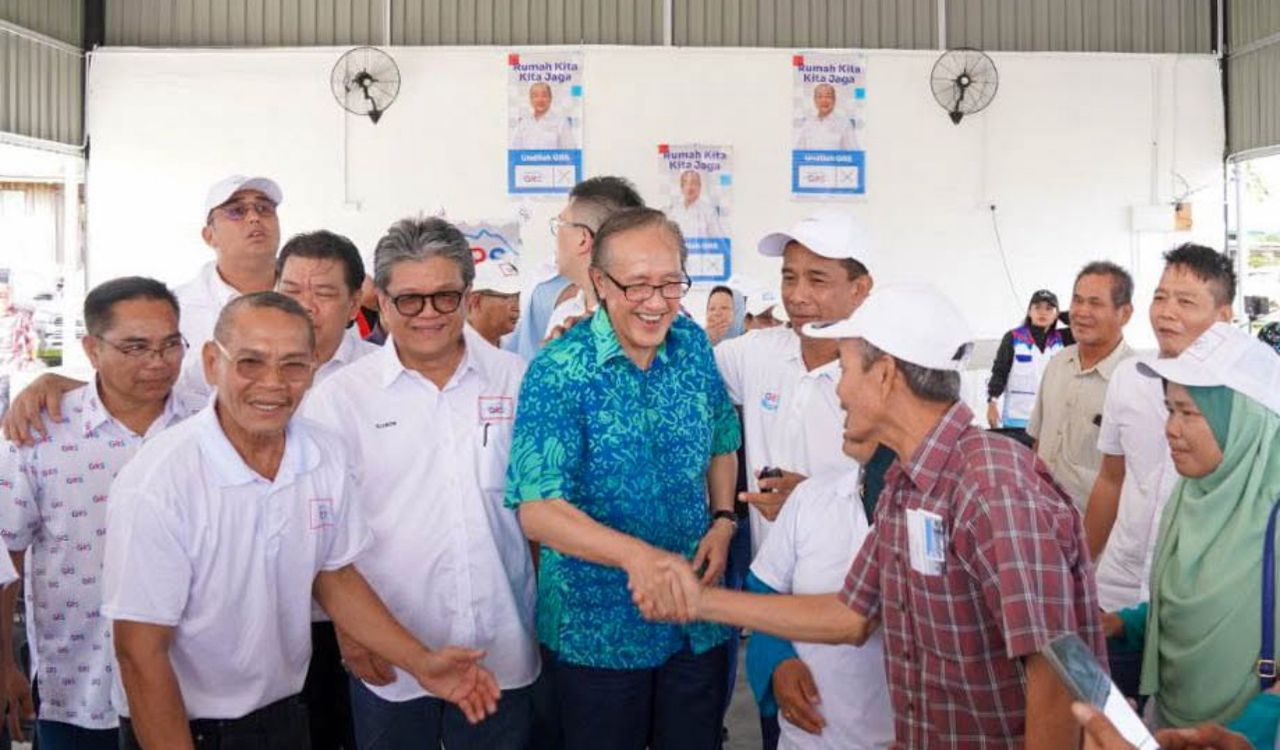
KENINGAU: Datuk Seri Masidi Manjun addressed local concerns over road conditions, education, state finances and Sabah’s long-term political stability during a public rally at Kampung Binuou, Sook, here today.
The event drew community leaders from Pensikol, Tunuh, Harikat, Sarayu and surrounding villages, many of whom described the session as timely given ongoing frustrations over basic infrastructure.
Masidi acknowledged that rural road conditions remain the community’s top priority. He revealed that the Ministry of Finance has instructed the Sabah Public Works Department (JKR) to prepare costings to asphalt village roads, with plans to include the project in next year’s development budget once technical details are finalised.He urged the public to understand the division of responsibility, explaining that not all roads fall under the state government.
Masidi noted that major routes such as Kota Kinabalu–Ranau and Keningau–Sandakan are federal roads and therefore fall under the federal government.
“State roads and district council roads are under Sabah’s responsibility, but limited funds currently allow the state to cover only about 70 percent of maintenance needs.
“That blame must be placed fairly, Sabah contributes significant tax revenue to the federation and deserves matching allocations for infrastructure,” he said.
Villagers repeatedly voiced their frustrations, telling Masidi that road upgrades should come first.
He responded that the government recognises this urgency but reminded the audience that road development is a shared obligation between state and federal authorities.
He added that just as the public criticises blackouts and water cuts without realising the federal ownership of utilities like Sabah Electricity (SE), many are unaware that the state does not control every key facility in Sabah.
“Misunderstandings like these fuel unfair criticism toward local leaders,” he said.
Education became the emotional core of Masidi’s speech, shaped by his own childhood experience of walking for days from Ranau to Tamparuli to attend school.
He said such hardship cemented his commitment to ensuring that talented Sabahan children are never denied opportunities because they lack political connections.
Masidi highlighted that scholarship allocation has doubled from RM62 million last year to RM121 million this year.
He also announced a major target: by 2027, all state-owned institutions under Yayasan Sabah will offer free tuition to Sabahan students.
He told the crowd that despite being the top Bumiputera student of his cohort, he once failed to receive a scholarship simply because he lacked political “cable,” a practice he promised will never be allowed to return.
Defending the GRS administration’s record, Masidi said the state’s financial reserves stood at RM2.9 billion when the coalition took over in 2020, but today Sabah holds RM8.6 billion, nearly triple the original amount.
He argued that this financial strength has enabled the government to continue welfare programmes such as RM300 monthly assistance for EKC registrants and free accident insurance for every Sabahan aged 30 days and above, which provides compensation of up to RM11,000 in the event of death or severe injury.
Masidi also updated the crowd on Sabah’s long-awaited 40 percent net revenue entitlement from the federal government, confirming that the first negotiation meeting has taken place.
“Once the funds are restored, part of the revenue will be placed into a trust fund to generate long-term returns, and two major benefits will be introduced: a monthly allowance for Sabahans aged 60 and above and state-funded housing deposits for first-time homebuyers who qualify for bank loans but cannot afford the upfront payment.
“These benefits depend on securing money that rightfully belongs to Sabah,” he stressed.
On water issues, Masidi clarified that many of Sabah’s current problems stem from the previous administration’s decision to terminate concession contracts for water treatment plants, which led to lawsuits from private companies.
He said the state lost all the cases and has paid about RM315 million in compensation, adding that more than RM1 billion has been spent this year alone to stabilise water supply, with hopes of resolving the West Coast’s water problems by next year.
Masidi also spoke about the importance of political stability, arguing that Sabah cannot be compared to Sarawak because Sabah has experienced 16 changes of chief minister while Sarawak has had only six.
This, he said, reflects decades of political turbulence that hinder development. He maintained that GRS has shown that with stability, state revenue and savings increase, social programmes expand and development becomes consistent.
In his closing remarks, Masidi appealed to the people of Sook and Persiangan to evaluate candidates rationally rather than emotionally.
He suggested that if voters elect both a federal minister and a state minister from the constituency, the area would enjoy greater development opportunities.
“If one becomes a federal minister and one becomes a state minister, kiri makan (the left benefits), kanan pun makanthe right benefits too),” he said, adding that the objective is not to oppose any individual candidate but to multiply the district’s access to resources.
He ended by telling residents that their votes should be guided by logic and long-term benefit, not political noise.